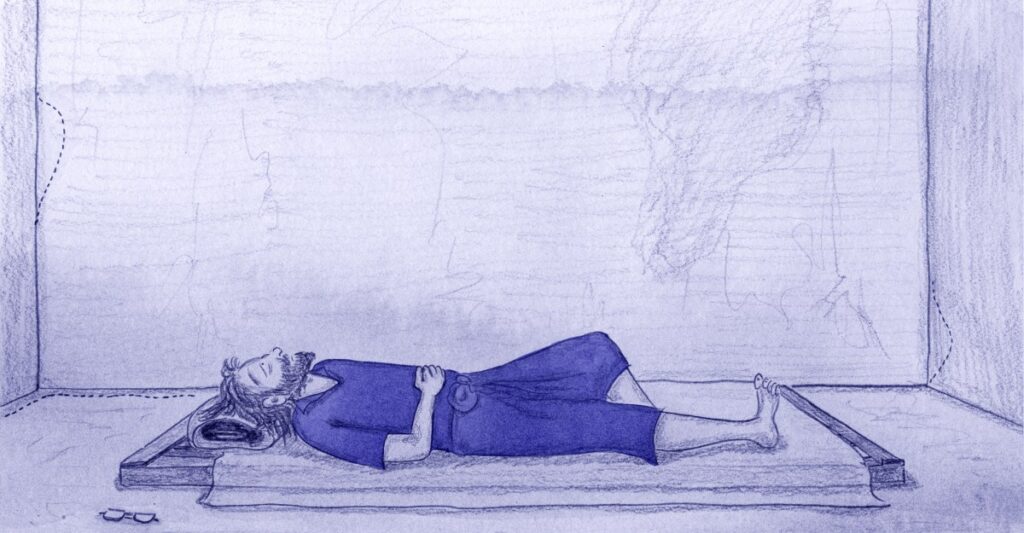
Jailed during the 2021 coup in Myanmar, American journalist Danny Fenster spent six months as a political prisoner. For much of his incarceration he battled boredom and fear, subsisting on meditation and podcasts on an SD card smuggled in by mail, sent by his girlfriend, Juliana.
Now, nearly five years after his release, he collaborated with his cousin Amy Kurzweil, a celebrated New Yorker cartoonist and graphic memoirist, on a long-form interactive comic for The Verge about his imprisonment. I chatted via email with Kurzweil about her role as an illustrator and storyteller in this ambitious long-form project, the responsibilities inherent in telling someone else’s story, and how she produced rich, multilayered drawings using only a pencil.
The Verge: Your work often focuses on family history, like your grandmother’s survival in a Warsaw ghetto and using AI to re-create your grandfather’s voice. What was your experience like helping to tell Danny’s story?
Any Kurzweil: When Danny was first imprisoned, I called my friend Ahmed Naji, a writer who had been imprisoned by Egypt’s authoritarian regime for nine months in 2016. He told me that the experience of unjust imprisonment can be worse for people on the outside; you care about the detained but have no information about what’s happening. I’m not sure I believe him, but I did appreciate Ahmed’s validation that the not knowing was a special kind of torture. That was part of my motivation for wanting to collaborate with Danny on this piece. I wanted to know what his experience was like, to know it in detail, and to allow myself some informed imagination of the reality I’d blindly groped at in my mind.
As you can imagine, Danny’s case was a big part of my family’s life in 2021. Along with Juliana, our family formed a kind of impromptu SWAT team dedicated to figuring out what to do. We met regularly with our embassy, and called on every resource we could think of. (We were organized — we had a Slack channel!) We met other people who’d experienced this special torture, and we corralled a community of people invested in the mission to #BringDannyHome and #ProtectThePress.
But we didn’t really know what Danny was experiencing. There was a profound disconnect between our banal daily realities and the unknowns of Danny’s detainment. I have a vivid memory of taking early morning meetings with former ambassadors while on a vacation in Disney World with my brother’s family, standing in line for It’s a Small World while posting about my cousin’s imprisonment. The disorientation of this experience had a profound effect on everyone in my family. We felt out of control. Helping to create a work of art that testifies to the details and specifics of what happened feels profoundly orienting. It’s healing. This is one reason why creative and immersive storytelling is so important: It gives us a prolonged feeling of being like, Ooh, that’s what it was like.

How did this creative collaboration work between you and Danny?
Danny is a gifted writer, and I was happy to take advantage of his desire to document his experiences and his openness to doing it in a multimedia way. We started with conversations, and worked together to figure out the slice of his experience that could translate well to a story for The Verge. We knew we wanted to highlight the importance of storytelling and media, both as a way to cope with uncertainty and as a way to connect people across literal and metaphorical bars. Danny began by writing prose, then we worked together to adapt his essays and selections from his prison journals to a comic script over Google Docs, and then I started sketching.

Tell us about your drawing process.
Drawing has always been my way to connect to a sense of the truth, for two reasons. The first is that drawing is embodied; it helps me feel and transmit emotion. The second is that drawing reveals details.
Danny sent me all the relevant pictures he had of Myanmar, along with his journals, which had a few sketches in them, but there are no public photographs of Insein Prison. We looked together at the Google Maps satellite view of the panopticon and he showed me his ward and explained what happened where. He drew me many maps — of his and Juliana’s apartments, of his ward and his cell, but the only other visual resource I could rely on was a collection of drawings by Maung Pho, a former prisoner in a different ward.
When I draw a space I can’t see, even in a simple style, I need so many questions answered: What was the floor of your cell made of? What was the texture of the walls and what was written on them? What did you see through the bars of your cell? Where was your bed and where did you keep your things? Oh, you really had a New Yorker tote in your cell for six months? Cool. Each drawing required revision; sometimes Danny needed to see me draw something — in detail — before he remembered what the space actually looked like. That wall was taller, and that wall had barbed wire on it, and there were weeds there, and there were no trees here… This comic required more back-and-forth revision of drawings than anything I’ve ever worked on. That’s partly why I drew the finals in pencil.
But it was so gratifying when I’d really get something right, and I’d think, Wow, drawing is the most magical technology there is.
“But it was so gratifying when I’d really get something right, and I’d think, Wow, drawing is the most magical technology there is.”
How did tech play a role in your drawing?
Danny and I relied heavily on texting to share images and clarify things as I worked. We were able to spend some time working and sharing notes in person, but most of our process happened with us across the world from each other: Me in the US, Danny in Vietnam, where he was living until recently. We also organized (somewhat chaotically) all our visual and textual resources in Google Drive folders.
I draw by hand. I like the direct connection with the paper, and I especially like drawing in pencil because of the friction and feel of the line. I do a lot of tracing, like how I held paper up to my computer screen to trace Danny’s handwriting from the scans of his prison journals. For my finals, I drew the under-draft in blue pencil, and then I’d “ink” with Blackwing pencils, which are thick and create beautiful darks.
A good scanner (and good scanner software) is so important: I use an Epson wide format with Epson Scan 2 software. Then in Photoshop, I discarded the blue pencil underlayer and tweaked the levels, so the dark pencil became higher contrast without losing grayscale and texture. Photoshop also became my canvas for playing with layout, and approximating how the flow of layers would work in the final animated version. I’m obsessed with how pencil marks look on a digital screen, and I think “inking” in pencil saves me a lot of process headache and preserves the initial feeling and flow of a spontaneous drawing.

How was technology a part of Danny’s experience in prison?
One of the first things Danny said to me when he got out of prison, which I’ll never forget, is that it was nice to be without his phone. This is not to downplay the suffering, but it’s typical of Danny to make an observation like that, to emerge from imprisonment noticing that he’d been offered something. One of the questions we wanted this story to explore was: If we are so inundated with information, with stories about suffering and hardship and injustice, how do we actually honor an individual news story? In a democracy, we need access to all of these stories, but how can we care about any one of them?
That’s to say nothing of all the untold stories. Danny and I are only in a position to tell his Myanmar story because he was lucky enough to be an American with some resources. We think the answer here has something to do with craft and emotion and immersion, what we hope this story offers readers, but it also has something to do with the mind of the story’s recipient.
The climax of this comic involves Danny receiving, from Juliana, a story that really moved him: a This American Life episode about another American imprisoned abroad. Danny had lost steady access to pen and paper, the basic technologies he’d originally relied on to make meaning and fill his time, so he’d been meditating, readying his mind for boredom, and then here comes… a podcast!
