
NEWYou can now listen to Fox News articles!
You open your inbox and see a message that instantly makes your stomach drop. Someone claims they have your passwords, your files, your credit card details and your entire digital life. They say they will sell everything on the dark web unless you pay them quickly.
One reader, Bobby D, wrote to us after receiving a message exactly like this.
“I received the attached email, and I’m wondering what to do. I have the capability to mark it as Spam with my email provider, Earthlink. Because of its threatening nature, is there any other type of action you can recommend? I was wondering if just designating as spam, there really would be no deterrence for the sender?”
It feels personal. It feels urgent. And it feels terrifying. Then you actually read the email. “I have your complete personal information… I will send this package to dark net markets… Or you can buy it from me for 1000 USD in Bitcoin…”
If this looks familiar, you are not alone. This exact extortion scam email is hitting inboxes everywhere right now.
Sign up for my FREE CyberGuy Report
Get my best tech tips, urgent security alerts, and exclusive deals delivered straight to your inbox. Plus, you’ll get instant access to my Ultimate Scam Survival Guide — free when you join my CYBERGUY.COM newsletter.
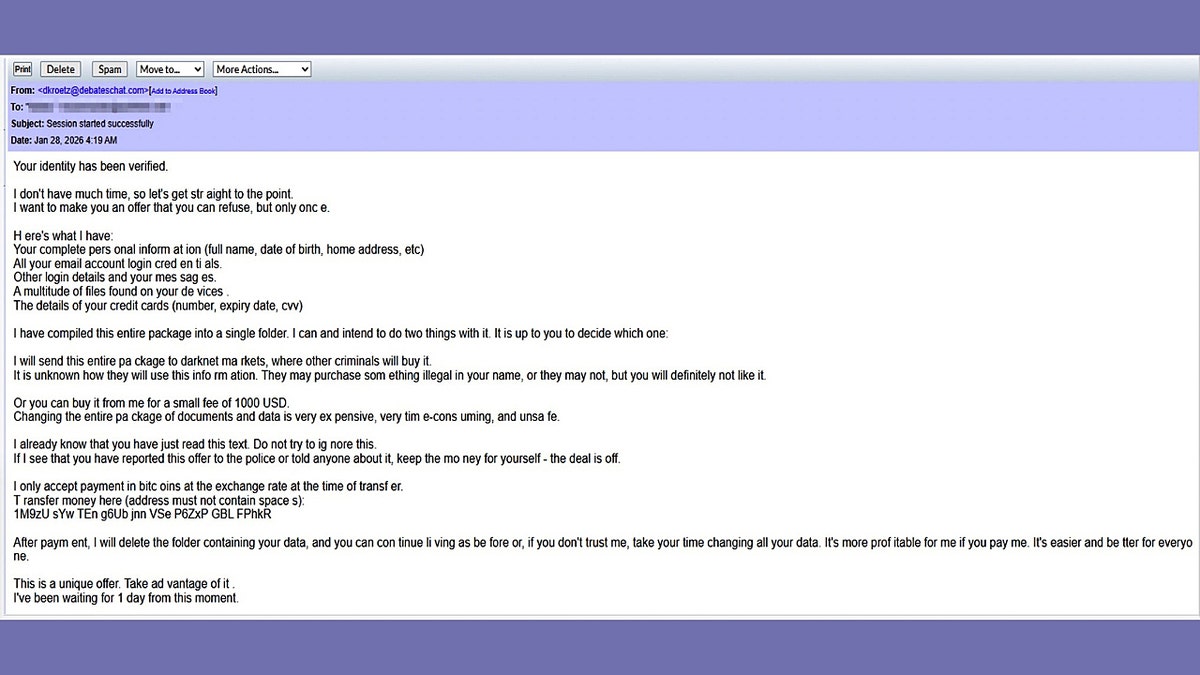
Extortion scam emails often claim hackers stole your data and demand Bitcoin, but they rarely include any real proof. (Kurt “CyberGuy” Knutsson)
Why this extortion email is a scam
At first glance, the message sounds confident and detailed. That is intentional. Once you slow down, the warning signs are obvious.
No proof of compromise
The sender claims they stole everything but provides no real evidence. There are no screenshots, no passwords and no files attached. Scammers rely on fear, not facts.
Vague language and sloppy writing
Phrases like “a multitude of files” and “your devices” sound dramatic but say nothing specific. Real breaches include details. Scams stay vague.
Bitcoin demand and urgency
Any email demanding Bitcoin while warning you not to tell anyone follows a classic scam formula. Legitimate companies do not operate this way.
Mass sent message
This email is not personal. It is part of a large campaign sent to thousands of addresses at once. The goal is to scare a few people into paying.
MICROSOFT ‘IMPORTANT MAIL’ EMAIL IS A SCAM: HOW TO SPOT IT

These messages rely on fear and urgency to push people into acting before they have time to think. (Photo by Annette Riedl/picture alliance via Getty Images)
How scammers got your email address
Here is the uncomfortable truth. Your email address likely appeared in an old data breach somewhere online. That does not mean your computer, phone or accounts are hacked. Scammers buy leaked email lists, then send threatening messages in bulk. Even one payment makes the entire operation profitable. They are playing the odds, not targeting you.
What to do right now
If you receive an email like this, here is the correct response.
Step 1: Do not reply
Responding confirms your address is active and can lead to more threats.
Step 2: Do not send money
Paying does not make you safer. It only signals that the scam worked.
Step 3: Mark it as spam or phishing
Flagging the email in EarthLink or any provider helps train spam filters. It reduces how often these messages reach you and others.
Step 4: Delete the message
Once it is reported, remove it and move on. To Bobby’s question, yes, marking it as spam absolutely helps. It does not stop the sender directly, but it protects you and others from future scams.
APPLE APP PASSWORD SCAM EMAIL WARNING

Slowing down and verifying information independently is often all it takes to break the scam’s grip. (Kurt “CyberGuy” Knutsson)
Ways to stay safe from extortion scam emails
You cannot stop scammers from trying. You can stop them from succeeding. These steps reduce risk and remove the fear factor.
1) Use unique passwords for important accounts
Reused passwords make old data breaches more dangerous. A password manager helps you create and store strong, unique passwords.
Next, see if your email has been exposed in past breaches. Our #1 password manager (see Cyberguy.com) pick includes a built-in breach scanner that checks whether your email address or passwords have appeared in known leaks. If you discover a match, immediately change any reused passwords and secure those accounts with new, unique credentials.
Check out the best expert-reviewed password managers of 2026 at Cyberguy.com.
2) Turn on two-factor authentication
Two-factor authentication (2FA) adds a second layer of protection even if a password leaks.
3) Keep devices and software updated
Updates close security gaps scammers rely on. Automatic updates offer the strongest protection.
4) Remove your personal data from the web
Data removal services help limit how much personal information scammers can find and misuse. By limiting the information available, you reduce the risk of scammers cross-referencing data from breaches with information they might find on the dark web, making it harder for them to target you.
Check out my top picks for data removal services and get a free scan to find out if your personal information is already out on the web by visiting Cyberguy.com
Get a free scan to find out if your personal information is already out on the web: Cyberguy.com
5) Avoid links and use strong antivirus protection
Never click links in threatening emails. Strong antivirus software helps block malicious sites and fake support pages. The best way to safeguard yourself from malicious links that install malware, potentially accessing your private information, is to have strong antivirus software installed on all your devices. This protection can also alert you to phishing emails and ransomware scams, keeping your personal information and digital assets safe.
Get my picks for the best 2026 antivirus protection winners for your Windows, Mac, Android & iOS devices at Cyberguy.com
6) Slow down when messages create urgency
Scam emails rely on panic and speed. Pausing to verify removes their power.
7) Reporting still matters even if it feels pointless
Many people wonder if marking these emails as spam does anything at all. It does. Spam reports help email providers identify patterns, block sender networks and reduce future scam attempts. You may not stop the individual scammer, but you help protect everyone else.
Kurt’s key takeaways
Extortion scam emails succeed because they hijack fear. They want you to act fast, alone and without thinking. The moment you pause, question the message and verify safely, the threat collapses. No stolen files. No hacked devices. Just a recycled script designed to scare. If you received one of these emails, you did the right thing by stopping and asking.
Have you ever received a threatening email that made your heart race before you realized it was a scam? What helped you spot it, or what would you do differently next time? Let us know by writing to us at Cyberguy.com
CLICK HERE TO DOWNLOAD THE FOX NEWS APP
Sign up for my FREE CyberGuy Report
Get my best tech tips, urgent security alerts, and exclusive deals delivered straight to your inbox. Plus, you’ll get instant access to my Ultimate Scam Survival Guide — free when you join my CYBERGUY.COM newsletter.
Copyright 2026 CyberGuy.com. All rights reserved.
Related Article