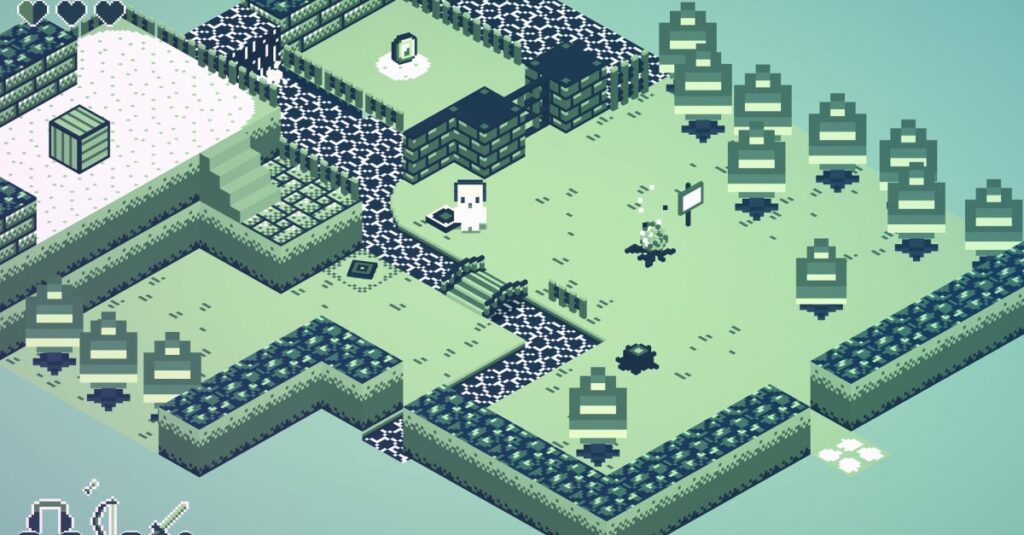
It’s no secret that Cassette Boy is inspired by the classics. It’s a top-down adventure game in the vein of a retro Legend of Zelda, while your home base is a small town like in an older Pokémon game, complete with a mom who is constantly wishing you well. The game’s blocky 3D graphics evoke Minecraft, and you save at campfires that reset the world, like a FromSoft game. Everything in Cassette Boy even has a green tint that reminds me of playing games on my original Game Boy. But despite all of the clear influences, it still feels unique: underneath that charming exterior, Cassette Boy is a game filled with clever puzzles that forced me to use my head in ways I haven’t before.
The game’s main mechanic revolves around an idea “inspired by” quantum mechanics: if you can’t see something in the game, it ceases to “exist” and remains in an essentially frozen state from the moment it went off-screen. If you push a block behind a wall, it’s not “there” anymore, and you can walk behind that wall without being impeded by the box. If an enemy goes fully behind a wall, it becomes invisible, will stop moving, and can’t damage you. Since it doesn’t exist, you also can’t damage it. The game also lets you rotate the camera to eight different points; imagine it’s on a compass, and with a tap of a shoulder button, you can rotate it to the north “point,” then northwest, then east, etc. So, with that hidden enemy, if you turn the camera so that it’s not behind the wall, it “reappears” and becomes a physical being again.
Cassette Boy then sets up a bunch of puzzles that force you to mess with perspective to overcome obstacles. Early on, you’ll come across a button that makes a platform appear on a river when the button is pressed down, and the button is next to a boulder. Everyone who has played a Zelda game knows that the usual solution would be to move the boulder to keep the button down. But you can’t pick up the boulder in Cassette Boy; instead, the solution is to step on the button and then turn the camera so that the boulder entirely hides the pressed-down button. That way, the button becomes frozen while pressed down, allowing you to hop on the platform to get to the other side of the river.
In addition to moving the camera, you get tools like a bow and arrow to hit switches and enemies from a distance and cassette tapes that give you powers to see bombable walls or shrink you down. When it all comes together, Cassette Boy is really satisfying: when I was in the zone, I couldn’t wait to pick apart every new room to work through puzzles and search for hidden treasures tucked away out of sight. There are also clever battles against giant, blocky bosses, all to earn moon fragments (the main MacGuffin you’re tasked to find).
Sometimes, though, Cassette Boy can be obtuse. There are no maps to refer to. You often have to talk to the exact right person at the exact right time to move the main quest forward, and you don’t have much of an indication of who that might be except for a speech bubble over their heads. After you collect a moon fragment, the game will send you back to the main town but won’t tell you where to go, so I often got frustrated having to seek out all of the townspeople over and over again. Some of the puzzles also totally stumped me, and I usually had a full-game walkthrough open during my nearly eight-hour playthrough so that I could get hints on how to progress next.
But I also think all that obtuseness is by design, and it harkens back to the game’s inspirations. With older Zelda and Pokémon games, I have fond memories of wandering around, getting lost, and eventually finding my way back on course with a sigh of relief. With all the time I spent struggling, I was forced to learn my way around those worlds, and now I can recall how to get through the toughest parts of those games even though I haven’t played them for years. (Even the developers of Breath of the Wild think that getting lost can be a “very positive thing.”)
Cassette Boy evokes that old-school spirit. Even when it frustrated me, I usually didn’t mind the struggle, and it helped me learn my way around. Usually, I realized that finding the right way forward just required a new perspective.
Cassette Boy is now available on PC, PlayStation, Xbox, and Nintendo Switch.
