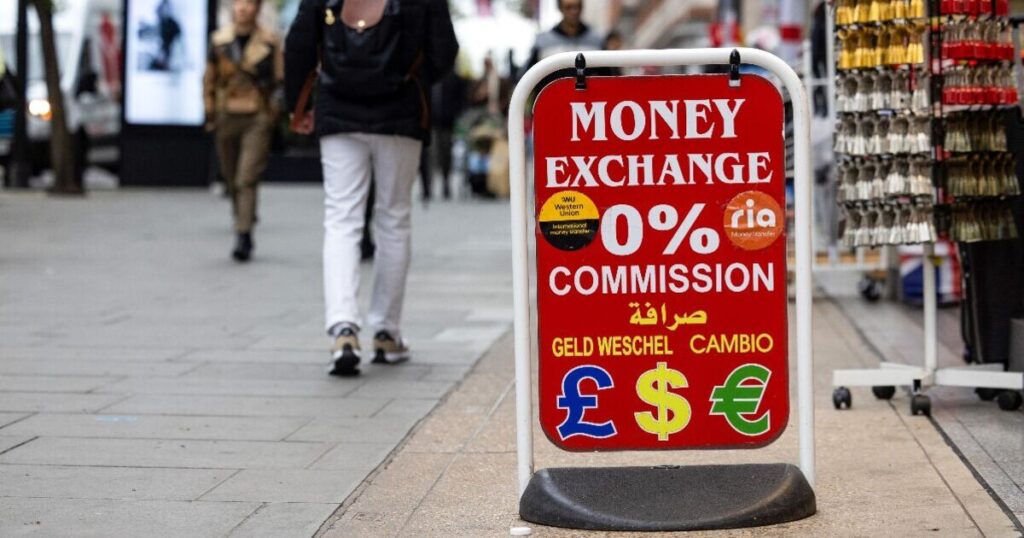

The pound dropped on news the unemployment rate increased to its highest level in five years (Image: Getty)
The value of the pound dropped sharply on news the unemployment rate increased to its highest level in five years. Figures from the Office for National Statistics (ONS) published on Tuesday showed the rate reached 5.2% in the three months to December.
It was the highest rate since the three months to January 2021 and upended most economists’ expectations of no change on the 5.1% rate recorded in the three months to November. The pound fell sharply on signs of pressure in the labour market. Sterling was 0.3% down at 1.359 US dollars and 0.2% lower at 1.147 euros on Tuesday morning.
Grant Slade, economist at US financial services giant, Morningstar, told the Daily Express: “The weakening of the pound reflects today’s labour force data points, which point to a further cooling in the labour market – as evidenced by both the further contraction in HMRC payrolls in January and a further deceleration in wage inflation in December.”
He added: “Traders are reassessing the medium-term outlook for UK interest rates, with sterling weakness reflecting rising expectations for a greater degree of monetary easing from the Bank of England.”
READ MORE: Rachel Reeves nightmare as unemployment rockets to highest level in five years
READ MORE: Millions of Brits urged to act now ahead of HMRC tax change in April
Financial Markets Online director, Samuel Fuller, said the labour market is in a spiral, not a spurt. He said cooling wage inflation and lower private sector wage growth raise expectations of an interest rate cut from the Bank.
Mr Fuller said global investors were dumping the pound amid expectations of a cut on March 19 from the base rate’s current 3.75%.
Traders ramped up bets on rate cuts, pricing in a 25 basis point cut in April and a 76% probability of a cut in March, Trading Economics reported.
Simon Phillips, managing director of travel money provider No1 Currency, said sterling’s drop against the dollar and euro would hit holidaymakers’ spending power.
He said: “Today’s sharp fall in the value of sterling means that Britain’s deepening economic gloom is even impacting families who’ve gone abroad to get away from it all.
“Sterling’s slide against the Euro, the US Dollar and many other popular holiday currencies means thousands of British travellers have seen their spending power take a half-term hit.
“Every meal or souvenir they buy will now cost just that bit more.”
Tony Redondo from Cosmos Currency Exchange said the pound-dollar exchange rate was projected to drift towards $1.33.
He said if the US Federal Reserve maintained a higher interest rate than the Bank of England, it would signal a divergence favouring the greenback.
Ensure our latest personal finance headlines always appear at the top of your Google Search by making us a Preferred Source. Click here to activate or add us as Preferred Source in your Google search settings.
The expert added: “Against the euro, the pound could slide toward €1.13 should the BoE cut more aggressively than the European Central Bank.”
Currencies fall in value when central banks lower interest rates because lower returns on assets make them less attractive to international investors.
Mr Redondo said unless inflation data published on Wednesday came in unexpectedly high, sterling’s downward trajectory would continue as confidence quietly drains from Britain’s economy.
Adam Hoyes, senior asset allocation analyst at wealth management group Rathbones, said initial data showed firms in the UK continued to reduce headcount at the start of this year.
He said growth in private sector regular earnings slowed to 3.4% year-on-year in the three months to December.
This was not far above the 3.25% the Bank of England recently announced as consistent with hitting its 2% inflation target.
Mr Hoyes said: “This is a key reason why investors are increasing bets on rate cuts by the Bank, prompting a rally in gilts and a weakening in the pound.”

Traders are pricing in interest rate cuts from the Bank of England (Image: Getty)
He said pay was still growing at a fair clip for public sector, retail and hospitality workers, outstripping the private sector average.
Mr Hoyes said minimum wage increases in April and an uptick in more recent hiring survey data suggested the Bank’s rate setters should not move too aggressively to cut interest rates.
Dr Sarah Zhang from Alliance Manchester Business School told the Daily Express the pound-dollar cross-rate had been seeing recent highs largely driven by a weakening US Dollar.
She added: “Looking ahead, the pound is likely to remain sensitive to further political developments domestically and the pace and timing of any Bank of England rate cuts.”
The ONS figures also showed the jobless rate among young people reached its worst level for more than a decade, with almost one in six left without a job.
News of sterling’s fall came after growth figures showed the economy recorded meagre growth of 0.1% in the final three months of last year fuelled by Budget uncertainty and a lacklustre performance in December.
